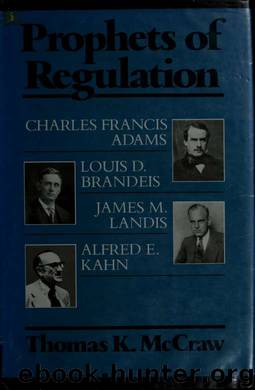
Prophets of regulation by Thomas K. McCraw
Author:Thomas K. McCraw
Language: eng
Format: epub
Tags: es index, 1835-1915, 1856-1941, 1899-1964
Publisher: Belknap Press
Published: 1984-03-15T05:00:00+00:00
LANDIS AND THE STATECRAFT OF THE SEC 199
Supreme Court's historic announcement, Landis wrote to the NRA indicating the SEC's willingness to administer the code. Then, as soon as the court's decision was announced, the SEC asked the Investment Bankers Code Committee to work out, jointly with the SEC, a permanent regulatory structure for the industry. Soon the code committee reconstituted itself as the Investment Bankers Conference Committee and began intensive discussions with the SEC. As usual, Landis gave a clear picture of the strategy, in one of his many speeches to businessmen: "Just as the disciplinary committees of the exchanges have been invaluable to us in our effort to supervise the activities on the exchanges, similar machinery would seem to be of value for the over-the-counter market. Under a self-imposed discipline it is frequently possible to lift standards . . . more than through legislation and regulation." 86
Months of close consultation followed, as the SEC and the Investment Bankers Conference Committee drafted and redrafted legislation to implement their goals. The commission aimed at a functional duplication of the SEC-supervised structure now in effect for the organized exchanges. The over-the-counter brokers and dealers hoped simply to gain respectability and parity with their competitors within the exchanges. Early in 1938, Senator Frank Maloney introduced the bill. (Maloney, a Democrat from Connecticut, was a friend of Douglas, who by then had succeeded Landis as SEC chairman.) The bill provided that the industry could set up, under SEC supervision, an association or group of associations open to any applicant engaged in over-the-counter transactions. This private agency could then fine, suspend, or expel those members whom it found in violation of the rules jointly worked out with the SEC. The Maloney Act specifically exempted the association from the antitrust laws, since collective behavior of the type contemplated might be in restraint of trade. 87
For its part, the industry responded by creating the National Association of Securities Dealers. The NASD had a central governing council and fourteen regional offices, a structure much like the SEC's own. At once, the association moved to regulate maximum fees for brokers' commissions, setting an informal upper limit of 5 percent. It began to investigate violations of the rules, both on its own motion and on referrals from the SEC. By law, NASD membership remained open to all comers, and the governance of the association seemed unusually democratic. No broker
Download
This site does not store any files on its server. We only index and link to content provided by other sites. Please contact the content providers to delete copyright contents if any and email us, we'll remove relevant links or contents immediately.
Hit Refresh by Satya Nadella(9144)
When Breath Becomes Air by Paul Kalanithi(8460)
The Girl Without a Voice by Casey Watson(7893)
A Court of Wings and Ruin by Sarah J. Maas(7867)
Do No Harm Stories of Life, Death and Brain Surgery by Henry Marsh(6947)
Shoe Dog by Phil Knight(5278)
The Rules Do Not Apply by Ariel Levy(4979)
A Higher Loyalty: Truth, Lies, and Leadership by James Comey(4974)
Hunger by Roxane Gay(4939)
Tuesdays with Morrie by Mitch Albom(4795)
Everything Happens for a Reason by Kate Bowler(4750)
The Immortal Life of Henrietta Lacks by Rebecca Skloot(4597)
Millionaire: The Philanderer, Gambler, and Duelist Who Invented Modern Finance by Janet Gleeson(4489)
How to Change Your Mind by Michael Pollan(4363)
All Creatures Great and Small by James Herriot(4333)
The Money Culture by Michael Lewis(4216)
Man and His Symbols by Carl Gustav Jung(4149)
Elon Musk by Ashlee Vance(4133)
Tokyo Vice: An American Reporter on the Police Beat in Japan by Jake Adelstein(4002)
